
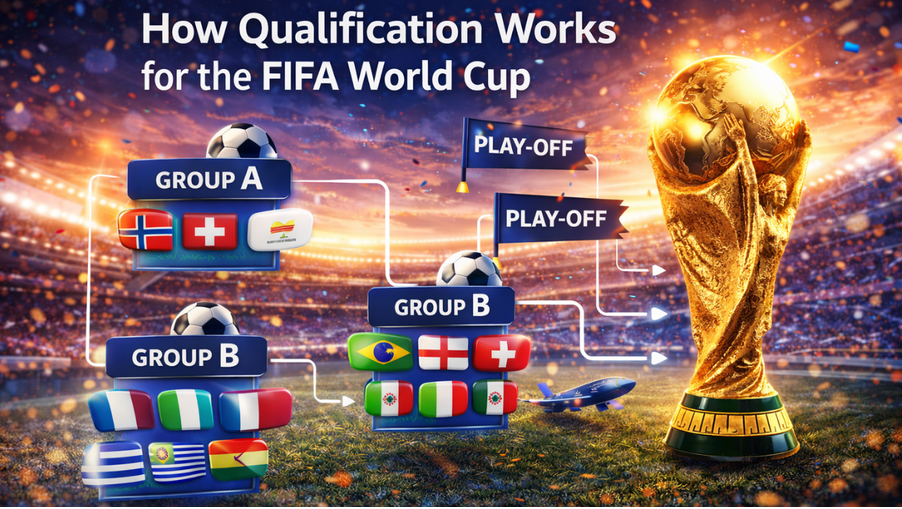
The FIFA World Cup is football’s biggest event. Simple as that. 48 teams. Three host countries. And over 200 nations are trying to get in.
Most won’t.
Before any of the World Cup 2026 matches start, almost every team has to earn its place. That’s what FIFA World Cup qualification is. Years of matches. Pressure every game. Fans follow it all through sports media, official FIFA sources, and platforms like MostBet – which track fixtures, results, and standings.
So… how does it actually work?
Overview of the FIFA World Cup Qualification System
FIFA doesn’t run qualifying itself. It hands that job to six continental confederations. Each one does it differently. Different formats. Different timelines. Different number of rounds.
What stays the same: the spots are limited. Always. That’s the whole point.
Fans tracking the tournament use Mostbet alongside official sources – standings, upcoming games, confederation updates all in one place.
FIFA Confederations
Six confederations. Every footballing nation belongs to one:
- UEFA – Europe (55 associations, Russia currently suspended)
- CONMEBOL – South America (10 teams)
- CONCACAF – North/Central America and the Caribbean (41 associations)
- CAF – Africa (54 associations, Eritrea withdrew in 2026)
- AFC – Asia (46 associations)
- OFC – Oceania (11 associations)
The formats differ a lot between regions. More than people realize.
Allocation of World Cup Spots
For 2026, FIFA went from 32 to 48 teams. That meant new spot allocations. UEFA got 16 direct berths. CAF nine. AFC eight. CONMEBOL and CONCACAF six each. OFC – for the first time ever – got one guaranteed spot. Two more go through the inter-confederation playoff.
First time all six confederations have a guaranteed berth. That’s history.
For those whose teams didn’t make it to the States – and there are plenty – 2026 still has football. Friendlies, Nations League rounds, continental qualifiers for the next cycle. Anyone tracking Nigeria next fixtures or similar will find the full schedule there, not just the marquee games.
Stages of World Cup Qualification
There’s no single format. Every confederation decides its own. But the World Cup qualification process usually follows the same general shape.
Preliminary Qualification Rounds
Smaller, lower-ranked nations often start earlier. A knockout round. A mini-group. Just to reach the main competition.
In CONCACAF, the four lowest-ranked teams played two-legged ties to even get to round two. In OFC, four teams played a three-match knockout just to reach the group stage. Seems harsh… but 206 countries can’t all start in the same group. Someone gets filtered out early.
Group Stages
This is where most of qualifying happens. Teams drawn into groups. Home and away fixtures against every other team. Points over months – sometimes over a year.
In Africa, 54 nations split into nine groups of six. Each group winner qualified directly. That’s it. No second chances.
Top of the group – you’re likely through. Second place – depends on what comes next.
Playoff Matches
Teams that finish second, or among the best runners-up, face extra rounds. Single-leg or two-leg knockouts. One bad night and it’s over.
Europe’s playoff for 2026 has 16 teams – the 12 group runners-up plus four Nations League group winners. Four separate paths. Two semifinals, one final per path. Four winners qualify.
Then there’s the inter-confederation playoff – teams from different confederations fighting for the last two spots. More on that below.
Qualification Rules by Region
World Cup 2026 qualifiers look different depending on where you’re from. Same tournament. A very different road.

European Qualification Format
UEFA World Cup qualifying format for 2026 was straightforward on paper – 54 teams, 12 groups, split between groups of four and five by draw. In practice it was anything but. Groups of five kicked off in March 2025, groups of four followed in September. Twelve group winners went straight through.
England, France, Croatia, Norway, Portugal, Germany, the Netherlands, Switzerland, Scotland, Spain, Austria, Belgium. Mostly the usual names – though Norway qualifying ahead of the pack raised a few eyebrows.
The FIFA World Cup European Qualifiers players still in the mix are heading into playoffs with very little margin for error. Italy in Path A, potentially up against Northern Ireland or Wales. Ireland, Denmark, Sweden, Turkey all still fighting. The spots are limited. The competition isn’t.
A high seed means nothing once the pressure kicks in. Germany wobbled badly before finding their footing. Scotland made it through for the first time since 1998 – that alone tells you qualification in Europe doesn’t follow a script. It never has. The group stage regularly produces results that the knockout rounds don’t, and that’s exactly what makes European qualifying worth following from the first matchday.
South American Qualification Format
CONMEBOL is the simplest format in world football. Ten teams. One table. Play everyone home and away. 18 matchdays total. Top six through. Seventh goes to the inter-confederation playoff.
No groups. No early knockouts. Just 18 games of South American football.
Which sounds fine until you remember who’s in that table. Argentina, Brazil, Colombia, Uruguay… every game is a war. Especially the South American classic Argentina-Brazil.
Other Regional Qualification Formats
Asia (AFC): Four rounds. 46 teams entered. Whittled down progressively. In round three, 18 teams split into three groups of six – top two from each group qualified directly. Japan went through first, beating Bahrain 2-0 in March 2025. Iraq headed to the playoff.
Africa (CAF): Nine groups. Nine automatic qualifiers. The four best runners-up then played a mini-tournament for one inter-confederation playoff spot. Nigeria reached that final… and lost to DR Congo on penalties. 1-1 after 90 minutes. Painful.
CONCACAF: USA, Canada, Mexico – automatic as hosts. Three more spots went to Panama, Haiti, and Curaçao. Curaçao’s population is around 155,000. They’re now going to the World Cup. Smallest nation to ever qualify.
Fans following African and CONCACAF teams use platforms like MostBet to track standings and schedules during international windows.
How Teams Earn Points During Qualification
Points System
The same everywhere:
- Win = 3 points
- Draw = 1 point
- Loss = 0 points
Clean. Simple. Brutal when the margins are tight.
In CONMEBOL, over 18 matchdays, the gap between direct qualification and the playoff was one point. Bolivia ended up seventh. One point off sixth. That’s it.
Tie-Breaking Rules
Equal on points? Then it gets complicated. Tiebreakers in order:
- Goal difference in all group matches
- Goals scored in all group matches
- Head-to-head points
- Head-to-head goal difference
- Head-to-head goals scored
- FIFA Fair Play rankings
- FIFA World Ranking (last resort)
In CAF Group C, South Africa finished above Nigeria on points. South Africa – straight to the World Cup. Nigeria, with Victor Osimhen scoring eight qualifying goals, had to go the playoff route. One point between them. That’s the margin entire careers hinge on.
Why World Cup Qualification Is Highly Competitive
Limited Tournament Spots
World Cup qualifiers are not friendly matches. This is serious business. In essence, the World Cup begins with the qualifiers.
Even at 48 teams, the numbers don’t get kind. Europe has 55 associations for 16 spots. Africa has 54 for nine. Asia had 46 going for eight. Most teams that enter qualifying won’t make it. That’s just the math.
FIFA qualifying matches carry enormous weight because of it. One bad result on a difficult away night… and a country is out. Four more years. That’s what’s at stake every single game.
Samuel Chukwueze said it clearly before Nigeria’s CAF playoff in Rabat: “The national team jersey is heavy when you wear it because you represent so many people… For me, the personal goal is to qualify for the World Cup because the last World Cup we missed out.”
They didn’t make it. DR Congo did. On penalties.
Global Competition
The World Cup draw took place December 5, 2025 – Kennedy Center, Washington DC. All 42 confirmed teams drawn into 12 groups of four. Four pots. Pot 1: three hosts plus the nine highest-ranked qualified nations.
Bleacher Report’s power ranking of every qualified team showed the full picture. Argentina to Curaçao. Defending champions to first-time qualifiers.
The FIFA Intercontinental Cup games for the last two spots – March 26 and 31, 2026. Guadalajara and Monterrey. Six teams. Two places.
MostBet covers qualifying fixtures and stats across confederations. The app is optimized for live tracking – access it directly via MostBet mobile to follow draws, results, and group standings in real time.
Creating an account is straightforward: MostBet registration takes a few minutes, and the platform unlocks full access to match data, odds, and account tools. During signup, a promo code MostBet field appears – worth filling in before confirming the account. Once registered, all account features become available, including MostBet withdrawal options with standard processing times.
Data Block: Qualification by Confederation – 2026
| Confederation | Example Teams | Spots | Qualification Method |
| UEFA (Europe) | England, France, Germany | 16 (12 direct + 4 playoffs) | Group stage + UEFA playoffs |
| CONMEBOL (South America) | Argentina, Brazil, Colombia | 6 direct + 1 playoff | Single round-robin table |
| CAF (Africa) | Morocco, Senegal, South Africa | 9 direct + 1 playoff | Groups of 6, home & away |
| AFC (Asia) | Japan, South Korea, Australia | 8 direct + 1 playoff | Multi-round knockout and groups |
| CONCACAF (N. America) | Panama, Haiti, Curaçao | 3 direct* + 2 playoffs | Round 1 → groups → Round 3 |
| OFC (Oceania) | New Zealand | 1 direct + 1 playoff | Knockout rounds |
*USA, Canada, Mexico qualify automatically as hosts.

FAQ
How do teams qualify for the FIFA World Cup? Each confederation runs its own campaign – groups, playoffs, knockouts. Format varies by region, but the logic is simple: finish high enough and you’re on the plane.
How many teams qualify for the 2026 World Cup? 48 total. USA, Canada and Mexico are already in as hosts. The other 45 earn it through qualifying – two of them through the inter-confederation playoff.
How long does World Cup qualification take? The 2026 cycle ran over two and a half years. Opened September 2023, last spots decided March 2026. Some confederations were in qualifying mode almost continuously throughout.
Which confederations participate in World Cup qualification? All six – UEFA, CONMEBOL, CAF, AFC, CONCACAF, OFC. First time in history every confederation had at least one guaranteed berth.
What changed between 2006 and 2026? A lot. Same six confederations, but 2006 had 32 teams with tighter allocations – Africa and Asia in particular got far fewer spots. The jump to 48 is the biggest format change since the tournament grew from 24 to 32 in 1998.
Do FIFA Club World Cup fixtures affect World Cup qualifying? No. Completely separate competition – club sides, not national teams, different calendar entirely. No overlap with qualifying at all.
Where can fans follow World Cup qualification matches? NBC Sports covers qualifying in detail. Official FIFA platforms and services like Mostbet also carry fixtures, results, and match statistics for international qualifying rounds.
Conclusion
Qualification isn’t just a formality. For most nations, it’s the whole journey. Years of matches. Near misses. Heartbreak. And sometimes – something unforgettable.
The 2026 cycle changed the rules in real ways. Bigger tournament. More spots. First guaranteed berth for OFC. But the margins stayed tight. They always do.
Fans in Uganda and across the world follow standings and results through official sources, sports platforms, and services like Mostbet – where qualifying data and international match info are available throughout the whole campaign.
Six teams. Two spots left. March 2026, Mexico.
And somewhere, a nation is already preparing for the next cycle to begin.
Leave a Reply