
A football preview can make a clear recommendation while leaving the reasoning difficult to assess. Readers gain more from understanding how the writer moves from information to a conclusion. A useful approach separates reported facts, assumptions, and the prediction itself. That structure supports an engaging sports discussion without treating confidence as certainty. It also leaves room for new information to change an assessment before the match, rather than making every later result appear inevitable.
Identify the Question Behind the Preview
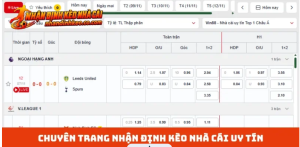
When exploring Nhận định kèo nhà cái, start by identifying the fixture and the type of article. A market explanation, a team preview, and an update to a quoted price may concern the same teams while answering different questions. Recognizing that difference prevents a general comment about performance from being used as an explanation of every condition shown elsewhere on the page.
Keep the publication date with the team names and competition. An article written before a lineup announcement has a different information set from a later update. If the context is missing, acknowledge the gap instead of filling it from memory. A familiar fixture name does not establish that the material applies to the current match or that it includes developments announced after publication.
Next, ask what the supporting data actually describes. A short run of results may involve opponents of different strength or conditions that do not match the next fixture. The figures can still be useful, but their relevance needs explanation. A longer table is not automatically a stronger argument if the reader cannot tell why its entries support the conclusion being offered.
Follow the Reasoning Without Turning It Into a Guarantee

The phrase nhan dinh keo nha cai can lead readers to commentary that combines historical information with a view about an uncertain event. Read those layers separately. A reported result is different from an interpretation of its significance, and both differ from a prediction. Seeing the boundaries makes it easier to ask which part is supported and which still depends on assumptions.
A persuasive argument should explain why a particular detail matters. Team selection, scheduling, and previous performances may contribute to an assessment, but none should be treated as a universal explanation by itself. Look for the connection between the detail and the question. If a preview names only favorable information, consider what relevant uncertainty has been omitted rather than assuming the missing side cannot matter.
Market information requires its own labels. A price without the selection, period, and stated conditions is incomplete. Likewise, a movement between two observations shows that the quoted terms have changed, not that a future result is known. Do not use a price change as automatic confirmation that a preview is correct. Any explanation of the movement needs evidence beyond the direction of the numbers.
Examples are valuable when they reveal assumptions rather than hide them. A case described after the final score can seem more obvious than it was beforehand. When reading a retrospective explanation, ask which information was available at the moment of the original decision. This protects the distinction between understanding an outcome and claiming that everyone should have predicted it with certainty.
Review the Article With a Balanced Record

Before a match, save the main reasons and the uncertainties together if you want to revisit the analysis. Keeping only the final selection makes later review less useful. A favorable result does not prove every reason was sound, and an unexpected score does not automatically invalidate every piece of information. The helpful question is how well the explanation matched the evidence available at the time.
Afterwards, consult relevant match reporting or statistics rather than selecting only the incidents that fit the initial story. Football has several phases, and a final score does not identify a single cause. Where the available information cannot support a complete explanation, leave the limit visible. A careful discussion can remain interesting without inventing certainty about why every event occurred.
Following a preview can remain an informational activity. You can compare arguments and enjoy the match without making a financial transaction. If real money is being considered, check legal eligibility and age requirements where you live, and establish limits separately from the prediction. Essential funds and borrowing should not be used to test a claim or recover a previous loss.
Choose a reading routine that fits your attention. There is no obligation to follow every update or remain on a page because another recommendation has appeared. A clear question provides a natural stopping point. Returning later with fresh information can be more useful than reacting continuously to a changing screen, especially when tiredness or excitement is beginning to replace careful interpretation.
Conclusion
Football predictions are more useful when readers can distinguish evidence, reasoning, and an uncertain conclusion. Dates, complete market labels, and a balanced review preserve the context needed to assess an article fairly. None removes the unpredictability of sport. The reader can appreciate analysis while retaining control over time, attention, and any spending decision, rather than allowing a confident sentence to become a personal guarantee.
Leave a Reply