
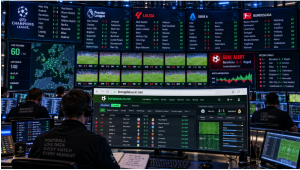
1. The Delay Dilemma: Why 30 Seconds Destroys Matchday Decision-Making
On any given Saturday afternoon across Europe, more than sixty competitive fixtures kick off at precisely the same minute.
For football evaluators, pools forecasters, and matchday trackers, this multi-match congestion creates an overwhelming sensory overload. You are tracking a favorite in England, an away underdog in Germany, and a high-stakes encounter in Italy all at once.
To manage this volume, the vast majority of followers rely on standard broadcast streams or sluggish generic apps.
They assume that when their screen flashes “GOAL”, they are watching reality in real time.
They are not.
Standard satellite broadcasts run on a 15-to-45-second latency delay. Free consumer websites refresh on cached, low-bandwidth server cycles that frequently lag minutes behind the actual physical action on the grass.
By the time a consumer app notifies you of a corner kick or an injury stoppage, institutional computers and pitch-side scouts have already registered the event, recalculated probabilities, and adjusted expectations. If your analytical workflow relies on delayed notification feeds, you are navigating live football with outdated instruments.
2. Telemetry vs. Scoreboards: What Really Occurs in the Live Phase
A static scoreboard tells you what already happened; real-time match telemetry tells you what is about to happen.
A match that sits at 0-0 on the 65th minute is never truly dormant. Beneath the surface score, the internal dynamics of the contest fluctuate wildly second by second. Performance trackers evaluate two real-time indicators that conventional scoreboards completely hide:
Dangerous Attack Clusters and Momentum Waves
Matches rarely produce goals out of steady, linear play. Instead, goals arrive in clusters of sustained pressure. When a team strings together four consecutive final-third entries, three corner deliveries, and two blocked shots within an eight-minute window, the defending structure begins to fracture. Live momentum telemetry registers this structural suffocation long before the ball crosses the goal line.
Rest-Defense Compression After Tactical Cautions
When an aggressive defensive midfielder receives a yellow card on the 35th minute, their physical behavior fundamentally changes. They can no longer commit tactical fouls to break up counter-attacks. Real-time foul telemetry immediately flags this vulnerability: the opponent will actively direct their transition runners through that specific defensive channel, drastically accelerating the pace of the game.
📊 Live Event Tracking Matrix: Delayed Alerts vs. High-Frequency Telemetry
- Goal Confirmation Speed
- Consumer Apps: 45 to 90 seconds delay (Subject to broadcast lag)
- High-Speed Telemetry: Sub-second server push (Synchronized with on-pitch data loggers)
- Match Context Information
- Consumer Apps: Basic possession clock and raw shot count
- High-Speed Telemetry: Dangerous attack momentum spikes, field tilt, and territorial heatmaps
- Red Card and VAR Interventions
- Consumer Apps: Late notification after on-field chaos concludes
- High-Speed Telemetry: Immediate notification of video reviews, injury stoppages, and tactical shape adjustments
- Weekend Fixture Utility
- Consumer Apps: Passive viewing tool for casual fans
- High-Speed Telemetry: Mission-critical tracking console for multi-match pools evaluators
3. The Multi-Match Challenge: Navigating Simultaneous Saturday Kickoffs
Tracking a single match is simple. Tracking forty matches across multiple leagues during a packed weekend afternoon requires institutional data infrastructure.
When ten matches enter the final ten minutes simultaneously, a single goal anywhere in the league tree alters qualification tables, pools coupons, and relegation margins.
The Necessity of High-Performance Live Hubs
This is where referencing high-frequency matchday platforms becomes essential. Navigating specialized live score hubs like Bongdalu provides analysts with the low-latency infrastructure required to track simultaneous fixtures without server timeouts or cached delay. Utilizing real-time score feeds and rapid matchday indexes ensures you receive instantaneous event updates, verified starting lineups, and live card alerts the second they occur, rather than relying on sluggish social media aggregators.
4. Reconciling Data Speed with Tactical Context
Speed alone is dangerous without verified tactical context.
A notification alerting you to an 85th-minute penalty is meaningless if you do not know the surrounding game state. Is the underdog playing with ten men? Has the opposing goalkeeper saved three of his last four penalties? Did the home side substitute their primary penalty taker five minutes earlier?
Grounding Speed in Verified Match Analytics
Before reacting to sudden matchday swings, instantaneous data must be matched with comprehensive pre-match statistical records. Cross-referencing live event trackers with detailed fixture archives and historical team records on vetted sports archives provides the qualitative baseline needed to interpret live data accurately. Knowing how a specific squad historically reacts to conceding an opening goal transforms raw score alerts into actionable tactical foresight.
5. The Live Tracker’s 3-Point Weekend Protocol
To ensure your matchday tracking remains precise across busy weekend cards, establish this fixed operational protocol:
- Eliminate Broadcast Bias: Never base your assessment of a team’s dominance on television commentator narratives. Monitor the raw frequency of dangerous attacks and box entries on an unvarnished live telemetry board.
- Track the Final 15-Minute Stoppage Wave: Referees in modern competitions routinely add eight to twelve minutes of stoppage time due to VAR interventions. Fixtures do not end at the 90th minute; track stamina degradation during extended added time where defensive errors surge.
- Consolidate on Low-Latency Engines: Ditch cluttered general news websites that crash during heavy weekend server traffic. Base your monitoring on lightweight, dedicated live score feeds that prioritize data transmission speed over intrusive graphic elements.
In modern European football, match events unfold at blistering speed.
When you eliminate latency, monitor in-play tactical momentum, and rely on synchronized real-time data engines, you stop chasing yesterday’s results—and start analyzing football at the true speed of the game.
Leave a Reply