
Fill a coupon on Wednesday and you know exactly what you have predicted. You do not know what it pays. That number turns up after the pool has closed, and most of what feels awkward about a pools week comes out of the delay.
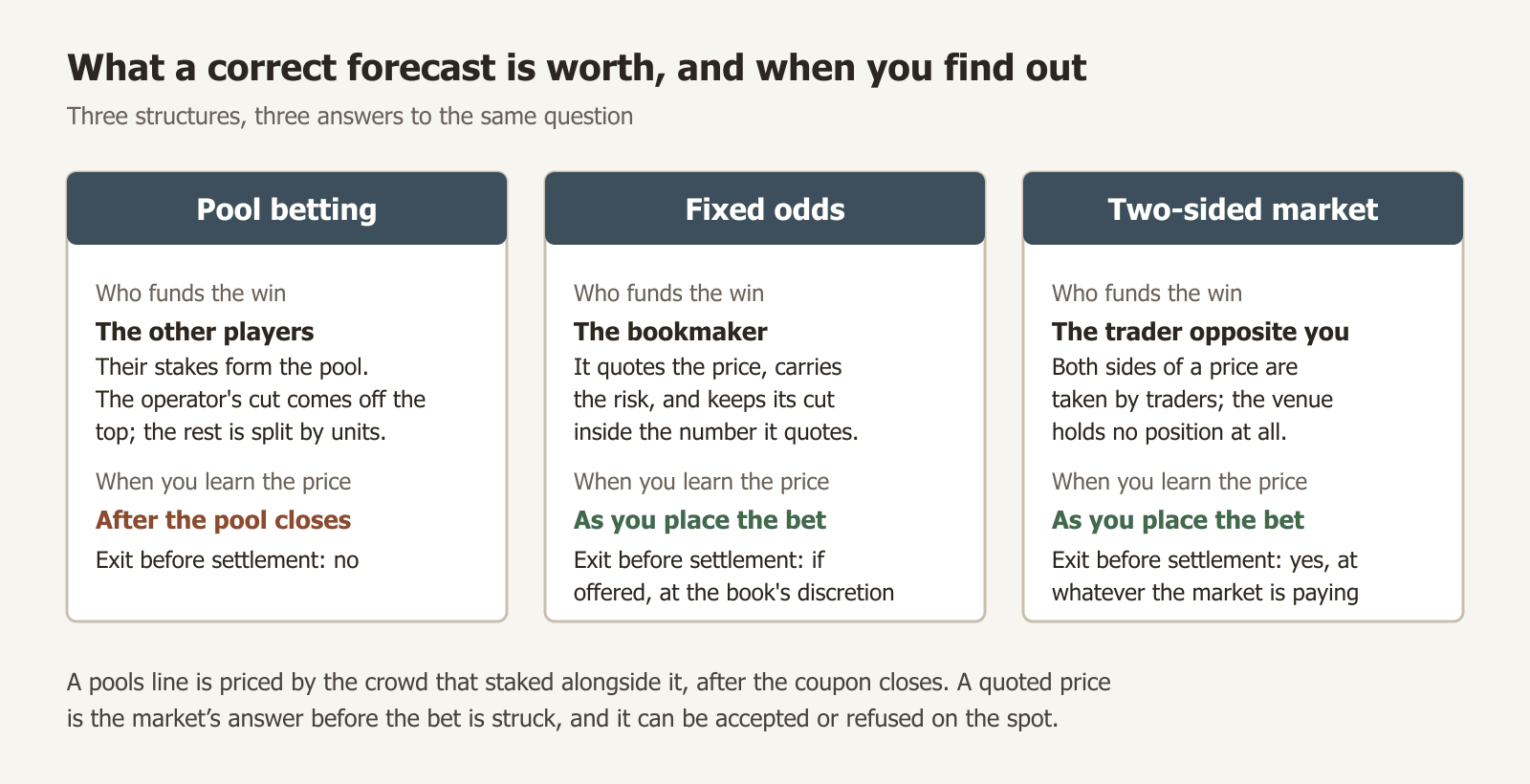
Fill in a coupon and the payout is still unknown; take a quoted price and it is settled on the spot.
What the dividend really depends on
The fund is the week’s stakes, less the operator’s cut and costs. What is left goes to the winning entries in each dividend division, split by the units they staked. Two units on a correct line collect twice what one unit collects.
Not every correct line reaches the top division. The pools have long paid several dividends down from the highest score, so a coupon can be right enough to collect and still collect from the smallest pot on the sheet.
That is why the games and the stake are two decisions rather than one. The games decide whether a line collects at all. The units decide how much of the fund it collects when it does.
None of that is a price anybody quoted. It is the result of what everyone else did, and the coupon does most of the work: a week full of draws pushes the odds down for everybody, because far more lines come good.
The room matters after that. When the banker room settles on the same three games and they land, the fund splits many more ways than in a week nobody could agree.
A price you can see, and a position you can leave
A fixed-odds slip fixes half of this. The price is on the screen when the stake goes down, so a punter knows what a win is worth. The other half stays open, because the bookmaker holds the other side and decides whether the slip can be cashed out early.
Some markets close both halves. On an exchange, both sides of a price are held by traders, and a position can be sold back into the same market before the game settles.
One way into that is the OVERDOG terminal, where prices come off Polymarket’s order book. Friday team news becomes something to act on rather than something to sit through.
Selling back is not a cash-out offer. The position goes back to the market at whatever other traders are paying at that moment, off the book of orders, not off a desk deciding what it will allow that day.
The cost is stated rather than buried: OVERDOG’s flat 1%, and Polymarket’s own published exchange fees.
Winning too often is a problem in exactly one of the three. A pool earns its cut whoever collects, so a good run costs it nothing at all.
A book pays the winner out of its own money, and a book that keeps paying the same customer eventually stops taking his bets. Where traders hold both sides there is nobody at the venue to make that call.
Why the pool’s number cannot come earlier
That delay is built into the structure. It is not a choice the operator made, and it shows up wherever a pool runs.
Put a pool and a bookmaker side by side on the same races and the fixed-odds price moves on the news first. The pool’s own running numbers stay close to useless, and only sharpen up as the betting goes on.
A coupon gives a punter even less than that. There is no running total on the wall to look at, and no way to tell on Thursday whether the week is busy or quiet. The first number anyone sees is the declared dividend, long after the last stake is in.
The pools have worked this way since the beginning. The first British coupon took a little over four pounds in stakes, and ten per cent came off the top before the winning dividend was paid. Everything since has been the same arithmetic with more zeros on it.
Two habits that work in any structure
Stake by the coupon, not by the week. Count the draws the fixtures are likely to throw up before deciding how many lines to run, because a heavy-draw week pays every winner less for the same work. The week’s fixtures go up days ahead, so the shape of the week is the one input settled before the money goes in.
Learn what a price is telling you. An exchange price is a probability wearing different clothes.
Reading a full card of football prices against your own view shows quickly whether an opinion is unusual. Unusual opinions are the ones that pay in a pool as well, because they are the ones fewest coupons carry.
Quick answers
How much can you win on football pools?
There is no set figure, because there is no price. The dividend comes off the size of the fund and the number of winning units sharing it, which is why an awkward week pays far more than a predictable one. It is also why two correct coupons in different weeks pay very differently for identical work.
What is a betting pool called?
In football it is the pools, or pool betting. The general name is parimutuel: everyone stakes into one fund, the operator takes its cut, and the winners share what is left in proportion to the units they staked.
Leave a Reply