
football match may show several prices for the same team:
- Home Win: 1.72
- Draw: 3.70
- Away Win: 4.90
- Home -0.5: 1.75
- Home -0.75: 1.98
All three home selections point towards the same team, but they do not always carry the same conditions. Home Win and Home -0.5 are often comparable in standard full-time markets, while Home -0.75 requires a stronger result.
Understanding what each market reveals is more useful than simply choosing the largest number. The 1X2 market prices the three possible match results, while the Asian handicap expresses the expected gap between the teams.
What the 1X2 market shows
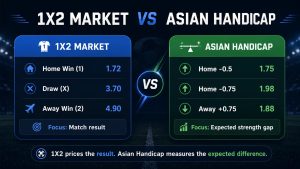
The 1X2 market contains three outcomes:
- 1: Home win
- X: Draw
- 2: Away win
Using the example above:
- Home: 1.72
- Draw: 3.70
- Away: 4.90
The home team has the shortest price, so it is considered more likely to win than the match ending in a draw or an away victory.
This does not mean the home team is certain to win. The prices reflect an assessment of the three possible results at that time.
The main advantage of 1X2 is simplicity. The draw remains a separate selection, and the reader can quickly see how the three results are priced against one another.
However, 1X2 does not directly show how large the expected gap between the two teams may be. A home price of 1.72 suggests the hosts are favoured, but it does not tell the reader whether they are expected to win narrowly or by a wider margin.
That is where the Asian handicap provides additional context.
What the Asian handicap shows
The Asian handicap applies a virtual advantage or disadvantage to one team.
A favourite may appear at:
- Home -0.25
- Home -0.5
- Home -0.75
- Home -1.0
These lines give a clearer view of the expected difference between the teams.
A small handicap such as -0.25 often suggests the teams are relatively close. A move towards -0.75 or -1.0 indicates that the favourite is being asked to overcome a more demanding condition.
Using the same example:
- Home -0.5: 1.75
- Home -0.75: 1.98
The -0.75 selection offers a higher potential return, but the handicap is harder to cover.
The basic meaning of the main lines is:
- Home -0.25: a draw produces a half loss.
- Home -0.5: the home team must win.
- Home -0.75: a one-goal win produces a half win.
- Home -1.0: a one-goal win returns the original amount.
Readers who need a closer look at quarter and whole-goal lines can review this Asian handicap guide with practical settlement examples.
For this comparison, the important point is that the handicap changes the condition of the selection. A higher price may simply reflect the fact that the favourite must achieve a stronger result.
When Home Win and Home -0.5 are comparable
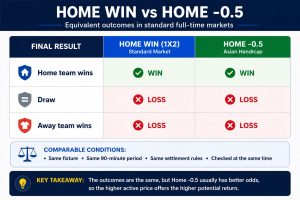
In standard full-time markets, Home Win in 1X2 and Home -0.5 on the Asian handicap usually have the same win-and-loss outcomes.
| Final result | Home Win | Home -0.5 |
| Home team wins | Win | Win |
| Match ends in a draw | Loss | Loss |
| Away team wins | Loss | Loss |
Using the example:
- Home Win: 1.72
- Home -0.5: 1.75
If both selections cover the same 90-minute period and use the same settlement rules, Home -0.5 at 1.75 provides the higher potential return.
The difference is small, but the comparison is valid because the outcome conditions are equivalent.
Before comparing them, confirm:
- Both markets cover the same fixture.
- Both refer to the standard 90 minutes plus stoppage time.
- Extra time and penalties are excluded.
- The prices were recorded at approximately the same time.
- The rules for postponed or abandoned matches are consistent.
Home Win and Home -0.5 should not be treated as automatically identical without checking those details. Some platforms may use different market periods or settlement terms.
Why Home -0.75 is different
Now compare:
- Home Win: 1.72
- Home -0.75: 1.98
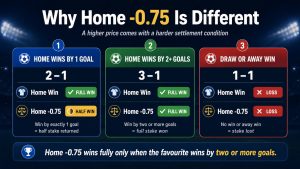
The -0.75 selection offers the larger number, but it also requires a stronger performance.
If the home team wins by exactly one goal:
- Home Win settles as a full win.
- Home -0.75 settles as a half win.
If the home team wins by two or more goals:
- Both selections settle as full wins.
If the match ends in a draw or an away victory:
- Both selections lose.
The higher price on Home -0.75 reflects the less favourable settlement condition when the favourite wins by only one goal.
This is why odds should never be compared without checking the line. A larger return does not automatically represent a better option when the selection is harder to settle as a full win.
The same issue appears in other handicap comparisons:
- Home -0.5 at 1.75
- Home -1.0 at 2.15
A one-goal home win fully wins -0.5 but only returns the original amount on -1.0. The higher price is attached to a greater requirement.
How to read both markets together
The two markets become more useful when viewed as a group.
Consider the full example:
1X2
- Home: 1.72
- Draw: 3.70
- Away: 4.90
Asian handicap
- Home -0.5: 1.75
- Home -0.75: 1.98
- Away +0.75: 1.88
The 1X2 market shows that the home team is favoured over the draw and away win.
The Asian handicap adds more detail. Home -0.75 suggests that the market does not only consider a home victory possible; it also gives some weight to the favourite winning by more than one goal.
A structured view of football odds on Keonhacai5 allows readers to review the Asian handicap, total-goals and 1X2 prices for the same fixture.
Looking at both markets together helps answer two separate questions:
- Which match result is considered more likely?
- How large is the expected difference between the teams?
The 1X2 market is better suited to the first question. The Asian handicap gives more information about the second.
What movement across both markets may indicate
Suppose the prices later change to:
- Home Win: 1.72 → 1.62
- Home -0.5: 1.75 → 1.65
- Main handicap: -0.5 → -0.75
All three changes point towards a stronger assessment of the home side.
The shorter Home Win price suggests the home victory is now being priced more strongly. The handicap moving from -0.5 to -0.75 also raises the condition attached to the favourite.
However, this movement is not proof that the home team will win. It may follow confirmed team news, injuries, rotation or a broader adjustment across several sources.
The timing also matters. A movement after the starting line-ups are announced has a clearer context than a small change several days before kick-off.
Which market is more useful?
Neither market is automatically better. The more useful option depends on what the reader is trying to understand.
1X2 is useful when:
- The focus is on the three main match results.
- The draw needs to remain a separate outcome.
- A simple comparison of home, draw and away prices is preferred.
Asian handicap is useful when:
- The expected strength gap matters.
- The reader wants to distinguish between a narrow and comfortable favourite.
- Different handicap levels need to be compared.
- The effect of a draw needs to be reduced or removed.
A team can be a clear favourite in 1X2 but still face a relatively moderate Asian handicap. That combination may suggest the team is expected to win more often than the opponent, without being strongly expected to win by a wide margin.
The best market depends on the question being asked, not on which price appears larger.
Common comparison mistakes
The first mistake is comparing Home Win with Home -0.75 as though they have identical conditions. A one-goal victory settles them differently.
Another mistake is focusing on the price while ignoring the handicap. Home -0.5 at 1.75 and Home -1.0 at 2.15 are not direct alternatives.
Prices should also be checked at the same time. A morning 1X2 price should not be compared with an Asian handicap price recorded after the team sheets have been announced.
The match period must also match. A full-time market cannot be compared with a first-half market, even when the team and price appear similar.
Finally, a shorter price should not be treated as certainty. Both 1X2 and Asian handicap prices reflect an assessment, not a guaranteed result.
Practical checklist
Before comparing the two markets, confirm:
- The fixture is the same.
- Both markets cover the same match period.
- The exact handicap has been identified.
- The prices were checked at a similar time.
- Home Win and Home -0.5 have matching settlement conditions.
- A higher price is not attached to a harder handicap.
These checks prevent most errors when reading 1X2 and Asian handicap prices side by side.
Conclusion
The 1X2 market prices the three possible results of a football match, while the Asian handicap shows the expected gap between the teams.
Home Win and Home -0.5 are often comparable in standard full-time markets because they share the same win-and-loss outcomes. Home -0.75 is different because a one-goal victory produces only a half win.
The larger number is therefore not always the better comparison. The market, handicap, match period and settlement conditions must all be checked before judging the potential return.
Leave a Reply