
Anyone who has ever nursed a pools coupon through a Saturday knows the feeling: a short list of chosen numbers, a draw you cannot influence, and that long afternoon between staking and knowing. Keno is the same feeling with the football removed. You mark numbers on a board, ten are drawn, and your payout depends on how many you matched. The instinct transfers completely. What does not transfer automatically is the pricing, and pricing is where pools veterans, of all people, should feel at home. So here is keno the way a banker-room regular would want it laid out: the structure, the true odds, and what the house actually keeps.
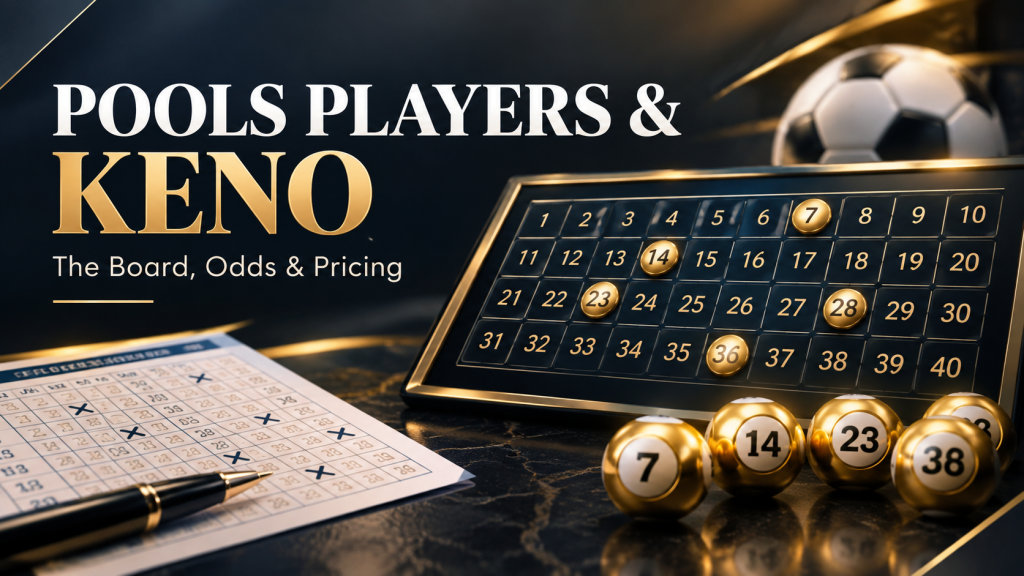
Two coupons, one instinct
Map the vocabulary across and the games nearly touch. Your keno picks are your nap and bankers. The drawn ten is Saturday’s results column. Choosing how many numbers to play is choosing between a banker slip and a full perm: fewer picks means modest returns that land often, more picks means a long-odds sheet chasing a big multiple. The staking math even rhymes. A perm any three from ten runs 120 lines and the cost scales with the ambition, exactly the way a bigger keno selection stretches the paytable taller and thinner. Anyone who can price a perm in their head already owns every skill this game requires. Even the folklore is identical, the lucky numbers, the systems, the cold streaks blamed on everything except arithmetic.
One difference matters immediately. A coupon settles once a weekend. A keno round settles in seconds, and the next board is always waiting. Keep that in mind for later, because it changes the cost of the habit more than any other single fact.
The board, priced
The version worth studying makes everything visible. Keno at Jacks Club runs a 40-number board, draws 10, and lets you mark from one to ten spots, with the full paytable for every combination printed before you stake. The game runs at a 98 percent RTP, tops out at a 1,000x multiplier, and offers four risk settings, Classic, Low, Medium and High, which reshuffle the same expectation between frequent small hits and rare heavy ones. The setting changes the shape of your Saturday, not the house’s share of it.
Read that paytable the way you would read a fixture list, because it is the entire contract. Every payout is sized against the true chance of the hit, minus the same two percent, on every line. No dividend announcement, no waiting on a pool size, no wondering what the payout will declare. The price of every outcome is public before the draw.
The true odds, in plain figures
Now the part almost nobody computes. Mark five numbers on a 40-ball board with ten drawn, and the raw chances are these: matching all five is 1 in 2,611. Four of five, 1 in 104. Three of five, 1 in 12.6. Those come straight from the counting arithmetic, and they are worth memorizing as calibration, because the board feels friendlier than that. Five little numbers on a small grid does not read like a 1 in 2,611 event. It is one anyway. The steadier way to see the board is through expected hits: mark five and the average round matches 1.25 of them, since each pick has a one in four chance of being drawn. Threes arrive on schedule, fours are occasions, fives are stories you retell.
And the fantasy line? Mark ten and match all ten and you are on a 1 in 847,660,528 chance. That is why the big multiplier is a cap and not a plan. The honest way to play keno, like the honest way to fill a coupon, is to price the middle hits, the threes and fours that actually arrive, and treat the top line as decoration.
What each game keeps
Here is the comparison that should genuinely surprise a pools player. Classic pools and lottery-style pool games commonly return half the pool or less to winners; keeping 40 or 50 of every 100 staked is normal for the format. Keno at a published 98 keeps 2. Per bet, it is not close. The casino game is more than twenty times cheaper.
But per hour is a different sum. The coupon charges its heavy toll once a weekend. Keno charges its light toll every thirty seconds for as long as you sit there, and 2 percent of a hundred fast rounds costs more than 45 percent of one slow one. Neither game is hiding anything; they are just charging on different meters. The player who understands both meters can choose deliberately, which is more than most players of either game ever do.
One more meter deserves naming: dividend uncertainty. A coupon can land your line and still pay modestly because the winning pool was crowded that week. A paytable has no weeks. What it printed is what it pays, crowded or not.
Staking rules travel better than luck does
The good news is that the discipline this community already practices is exactly what keno requires. Flat stakes, a fixed weekly amount decided in daylight, a record of what was staked and what came back. The banker-room habit of writing everything down, week in and week out, is worth more at a casino than any pattern theory anyone has ever printed or sold.
Two warnings translate directly. Chasing is more dangerous here purely because the rounds are fast: double after four misses and the fifth ticket costs sixteen times the first, with the board’s memory as blank as ever. And streak logic dies completely, since every draw is fresh; ten cold rounds promise nothing about the eleventh. The draw does not know you are due. It never did on the coupon either, but the coupon at least made you wait a week between lessons.
So borrow the coupon’s rhythm on purpose. Set a session stake the way you set a weekend’s pools budget, a fixed figure that would not embarrass you read aloud, and when it is gone, the session is over. The fast meter only hurts players who let the game set the pace.
Where you play decides half of it
The last piece of pricing is the operator, because a paytable is only as good as the site honoring it. The checklist is short and mechanical: a real license, an RTP published per game rather than promised in general, outcomes you can verify after the draw, sensible coins and networks for deposits, bonus terms whose turnover math you have actually run, and a withdrawal that arrives in minutes rather than excuses. All six checks, with how to run each one before any money moves, are laid out in this guide on what to check before funding a crypto betting site.
Run the checks once and the rest is the part pools players were built for: pick your numbers, price your ticket honestly, stake like an accountant and enjoy the draw. The instinct was never the problem. The arithmetic was just waiting to be invited along, and it turns out to speak fluent pools.
Leave a Reply