
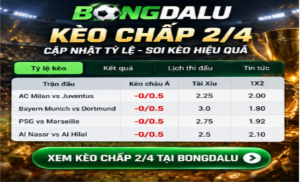
Football odds can contain fractions and numerical formats that are confusing to newcomers. One example is the expression “2/4 handicap.” Depending on how a particular source formats its information, users should first verify exactly what the notation represents rather than assuming that every website uses identical terminology. Platforms such as BONGDALU may be consulted alongside fixtures, results, team form, and other football information when learning how different market formats are displayed.
The most important principle is that handicap figures describe a framework for comparing two sides. They do not guarantee the result of a football match.
What does a football handicap represent?

A handicap creates a theoretical adjustment between two teams.
One side is generally considered the stronger team for the purpose of the displayed market, while the other receives a numerical advantage. The final score can then be interpreted after that adjustment is applied.
This differs from simply asking which team will win the match.
The handicap format attempts to represent a perceived difference between the two sides at a particular moment.
Why notation needs to be checked
Football information websites do not always present fractional handicaps in exactly the same way.
Some use decimals, others use fractions, and terminology can vary by language or region. Therefore, if a source displays “2/4,” users should check the site’s own market legend or rules to confirm its intended numerical meaning.
This is particularly important because confusing two handicap levels can completely change how a result is interpreted.
A reliable approach is to understand the notation first and analyze the teams second.
Why handicap figures move

The numbers visible several days before kickoff may not remain unchanged.
Football is a constantly developing information environment.
A key player might suffer an injury in training. A manager may announce squad rotation. Weather conditions may become relevant, or confirmed lineups may differ from expectations.
New information can alter how the relative strength of the teams is assessed.
Movement should therefore be understood as a changing assessment rather than proof of what will happen in the match.
Reading Tỷ Lệ Kèo with recent form
When examining Tỷ Lệ Kèo, recent results are an obvious place to begin, but the win-loss record alone is insufficient.
Imagine Team A has won its last four matches while Team B has won only twice.
At first glance, Team A appears to be in substantially better form. However, Team A may have faced four teams near the bottom of the table while Team B played several championship contenders.
Opponent quality changes the interpretation.
Performance can also matter. A narrow victory in which a team allowed numerous clear opportunities may be less convincing than the final score suggests.
Home and away context
Venue can influence football performance.
Teams may be more comfortable at their own stadium because they avoid travel and operate in familiar surroundings. Support from home fans can also affect the atmosphere of a match.
Nevertheless, home advantage should not be treated as an automatic rule.
Some teams have relatively small differences between their home and away records. Tactical styles can also produce unusual patterns.
Checking actual home and away data is therefore more informative than relying on assumptions.
Squad availability
Player availability is one of the most important pieces of pre-match information.
The absence of a starting goalkeeper can affect defensive confidence. Losing a creative midfielder may reduce the team’s ability to progress the ball, while an unavailable striker can change the attacking structure.
The importance of an absence depends on squad depth.
A club with several high-quality alternatives may adjust easily, whereas a smaller squad may have difficulty replacing a key player.
Tactical matchups matter
Football is not simply a comparison of individual player quality.
Styles interact.
A possession-oriented team may struggle against an opponent that defends compactly and counterattacks quickly. A side that relies heavily on crosses may face difficulties against dominant central defenders.
For this reason, two teams with similar overall records can produce very different performances depending on the tactical matchup.
Numbers should be interpreted alongside the way each team actually plays.
Do head-to-head records matter?
Previous meetings can provide context, especially when they are recent.
However, old head-to-head statistics can easily become misleading.
Managers change, players move between clubs, and tactical systems evolve. A meeting from four or five years ago may involve almost none of the players expected to start today.
Recent team information should generally be given more relevance than distant historical results.
Odds do not remove uncertainty
Even detailed analysis cannot eliminate unpredictability from football.
A red card can transform a match. A goalkeeper can make an unusual mistake. A penalty, deflection, or injury can change the tactical balance instantly.
This is why statistical advantages should never be interpreted as certainty.
Data can help users understand why one outcome may appear more or less likely, but probability and certainty are fundamentally different concepts.
Conclusion
A 2/4 handicap should first be interpreted according to the exact notation used by the information source. Once the format is clear, users can place the number alongside recent form, opponent quality, venue, player availability, and tactical matchups.
When viewing BONGDALU or Tỷ Lệ Kèo information, the objective should be to understand what the data represents rather than treat it as a guaranteed prediction.
Football remains inherently uncertain. Statistics can improve analysis, but they cannot remove the possibility of unexpected events or guarantee a future result.
Leave a Reply