
Football betting can appear simple at first glance. A match is scheduled, bookmakers publish odds, and bettors choose the outcome they believe is most likely. However, understanding how to analyze football odds is an essential skill for anyone who wants to make more informed betting decisions.
Odds are not simply predictions of what will happen. They also reflect the bookmaker’s assessment of probability, market demand, and the margin built into the betting market. This means that identifying the most likely winner is only one part of the process.
A strong betting approach involves comparing your own assessment of a match with the odds available and determining whether the potential return accurately reflects the risk involved.
What Football Betting Odds Actually Represent
Football odds are essentially a way of expressing probability and potential payout.
For example, if a team is offered at relatively short odds, the market considers it more likely to win than an opponent with longer odds. However, short odds do not guarantee success.
A favorite can lose, and an underdog can produce a surprise result. This is particularly common in football, where one goal can completely change the dynamics of a match.
Bettors researching on Repcet and looking for football tips should therefore treat odds as one piece of information rather than an automatic recommendation.
Converting Odds Into Implied Probability
One of the most useful skills in football betting is understanding implied probability.
For decimal odds, the basic calculation is:
Implied probability = 1 ÷ decimal odds × 100
For example, odds of 2.00 imply a probability of 50%, while odds of 4.00 imply a probability of 25%.
This calculation allows bettors to compare their own estimated probability with the market’s implied expectation.
If you believe a team has a 60% chance of winning but the available odds imply only a 50% probability, you may have identified a potential value opportunity.
Of course, estimating the true probability is the difficult part.
Why the Shortest Odds Are Not Always the Best
One of the most common mistakes among inexperienced bettors is assuming that the shortest odds represent the best bet.
A favorite may have a strong chance of winning, but if the odds are extremely low, the potential return may not justify the risk.
For example, a team may be priced as a heavy favorite because of its reputation, recent success, or popularity among bettors. However, its actual advantage over the opponent may be smaller than the market suggests.
The goal should therefore be to identify value rather than simply predict the winner.
Compare Different Bookmakers
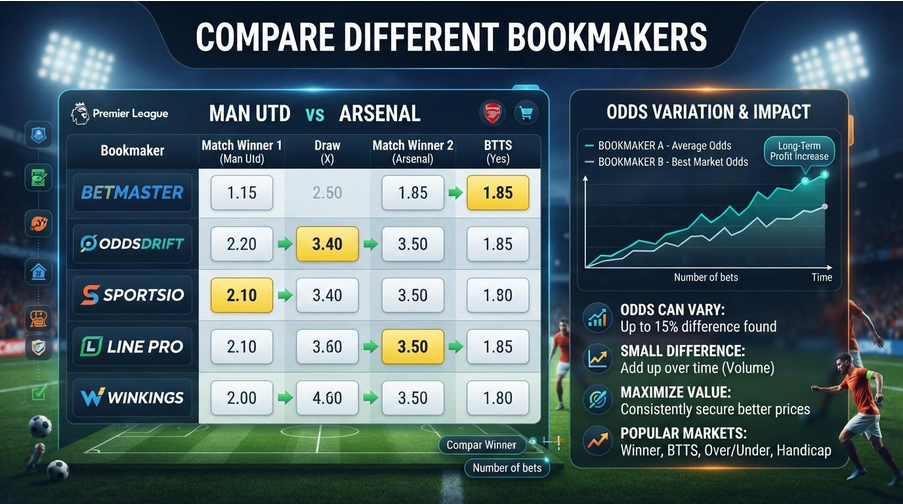
Odds can vary between bookmakers, sometimes significantly.
A small difference in price may seem unimportant for a single bet, but consistently finding better odds can have a meaningful impact over a large number of wagers.
Before placing a bet, it can be useful to compare the available prices for the same market.
This is particularly important for popular markets such as match winners, both teams to score, over/under goals, and handicap betting.
Look at More Than the Match Winner Market
Football betting offers many different markets, and the match result is only one option.
Depending on the fixture, bettors may consider:
- Both teams to score
- Over or under total goals
- Draw no bet
- Asian handicap
- Correct score
- Team-specific goal totals
- First-half markets
A strong analysis of the match may reveal that the best opportunity is not necessarily the outright winner.
For example, two evenly matched teams may be difficult to separate in the 1X2 market, but their attacking statistics could suggest that both teams have a strong chance of scoring.
Check the Context Behind the Odds
Odds should always be considered alongside the circumstances surrounding the match.
Injuries, suspensions, fixture congestion, and managerial changes can influence the probability of different outcomes.
A team competing in European competition may rotate its lineup before an important continental match. Another club may be fighting for survival and approach every remaining fixture with maximum motivation.
These details can sometimes explain why the market price appears unusually high or low.
Use Statistics to Challenge the Market
Statistics can help bettors determine whether odds accurately reflect a team’s current performance.
Useful indicators include expected goals, shots on target, possession, defensive records, home and away results, and recent performances against similar opponents.
However, statistics should be interpreted carefully.
A team’s recent winning streak may have come against weaker opponents, while an apparently poor run could include several difficult fixtures against elite clubs.
The quality of opposition should always be part of the analysis.
Watch for Changes in the Betting Market
Football odds can move significantly before kickoff.
A major injury, confirmed lineup, unexpected suspension, or significant betting activity can cause prices to change.
Monitoring these movements can provide useful information, although bettors should avoid assuming that every odds movement represents a reliable prediction.
Sometimes the market reacts to public sentiment rather than new information.
The key is to understand why the odds have changed before deciding whether the new price represents better or worse value.
Building Your Own Football Betting Pick
The best betting picks usually begin with an independent assessment.
First, analyze the teams and estimate the probability of each possible outcome. Then compare your assessment with the available odds.
If your estimated probability is higher than the probability implied by the market, the selection may offer potential value.
This process encourages bettors to think in terms of probabilities rather than certainty.
No football bet is guaranteed, but a consistent focus on value can help create a more disciplined approach.
The Real Edge: Finding Value Where Others Don’t Look
Analyzing football odds is ultimately about understanding the relationship between probability and price.
A successful betting pick is not necessarily the team most likely to win. It is the selection where the potential return appears greater than the risk suggested by the odds.
That distinction can completely change how bettors approach football matches.
Instead of asking, “Who will win?” a better question may be, “Are the odds accurate?”
The answer requires a combination of statistical analysis, team news, tactical understanding, and market awareness.
Football remains unpredictable, and even the strongest analysis can be overturned by a red card, penalty, injury, or moment of individual brilliance. However, by carefully analyzing odds and comparing them with your own assessment of a match, you can make more informed betting decisions.
The smartest bettors do not chase every favorite or follow every popular prediction. They look for discrepancies between the market and their own analysis, understand the risks involved, and focus on finding value over the long term.
That mindset turns football odds from simple numbers on a betting screen into a valuable analytical tool for evaluating the probability and potential value of every betting opportunity.
Leave a Reply